
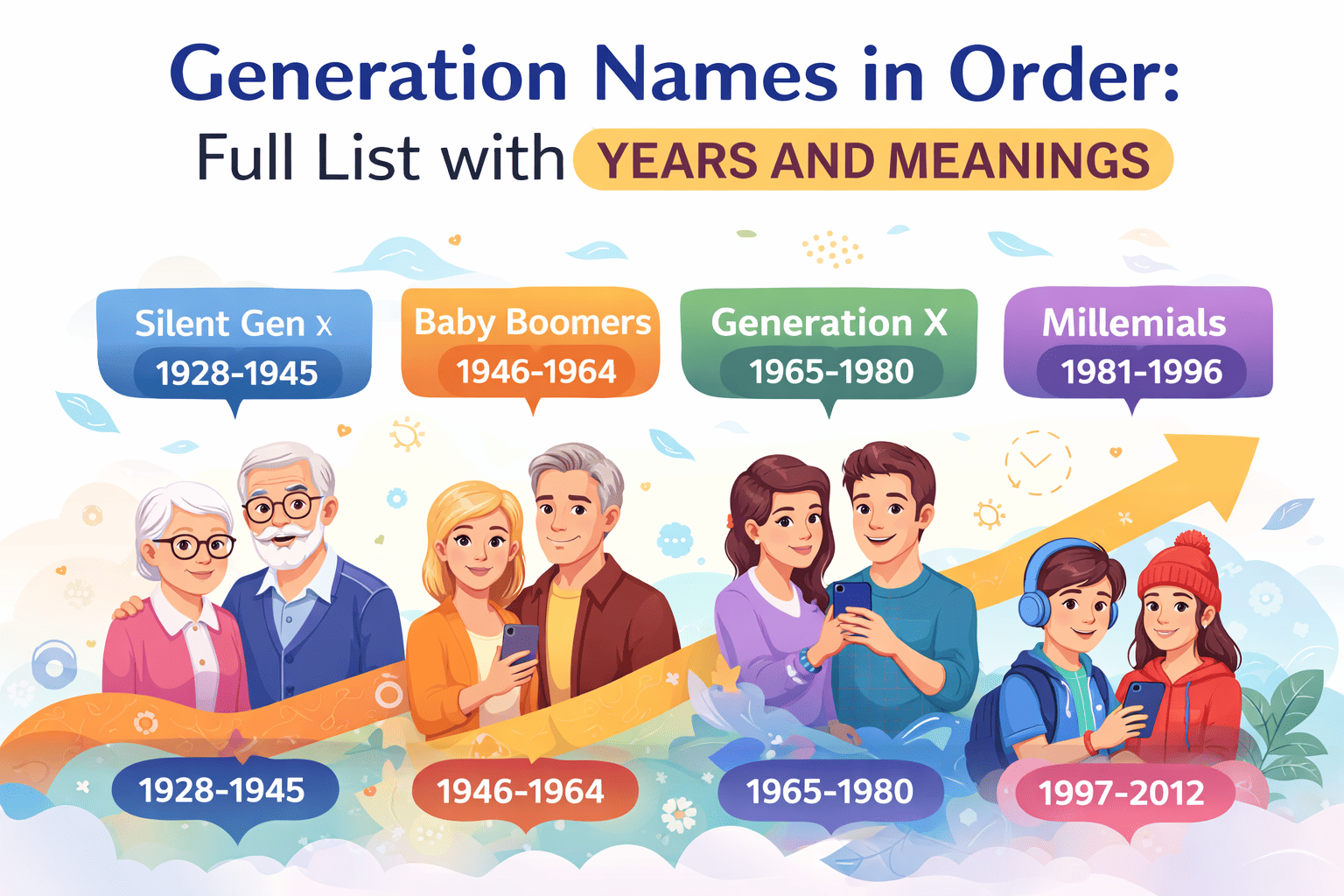
Most people do not learn generation names in school. They pick them up casually from conversations at work or from news headlines or from jokes online or from family disagreements that start with, “Your generation does not understand…” and end with someone leaving the room.
At some point, the labels stick like Baby Boomer. Gen X, Millennial, Gen Z, etc. They start sounding official, as if they were always there, neatly defined, universally agreed upon. But they were not.
Generation names were created slowly, often after the fact, by people trying to explain patterns they were already seeing. They are not exact science. They are closer to cultural shorthand. Useful, imperfect, and often misunderstood.
To really understand different generation names, you have to stop treating them like rows in a table and start seeing them as overlapping life experiences shaped by timing.
What Are the Generation Names, Really?
When people ask what are the generation names, they usually want a list. Years included. Clean edges.
But generation names were never meant to be sharp lines. They exist because people noticed that those born around the same time tend to share reference points.
Wars, economic cycles, technological shifts and cultural moments that hit at exactly the wrong or right age. Those shared reference points shape outlook more than birth certificates ever could.
That is why generation names and years are always approximate, no matter how confidently they are presented.
Why Generation Names Are Always Argued About
If you have ever searched for generation names by year, you have probably noticed something frustrating. The dates change depending on where you look. That is not sloppy research. That is reality.
Someone born in 1980 may feel nothing like someone born in 1996, even though they are often grouped together. Someone born in 1997 may relate more to Millennials than Gen Z, depending on how and where they grew up.
Generations fade into each other. They do not switch overnight. This is important to remember before treating any generation names list and years as absolute truth.
The Earliest Commonly Used Generation Names
Most modern discussions start in the early 1900s. Earlier generations existed, of course, but they are rarely referenced in everyday conversation now.
This is where generation names in order usually begin.
The Greatest Generation (Born roughly 1901 to 1927)
This generation did not grow up with many choices. They came of age during economic collapse and global war. Survival shaped their worldview. Stability mattered more than self-expression.
Many fought in World War II. Those who did not still lived with rationing, uncertainty, and loss. Hard work was not a value statement. It was necessity.
The name “Greatest Generation” came much later, looking backward with admiration.
When people talk about discipline, sacrifice, and community responsibility, they are often referring to habits shaped during this time.
In terms of generation names and ages, very few from this group are still alive today.
The Silent Generation (Born roughly 1928 to 1945)
The Silent Generation grew up watching the world rebuild itself. They were shaped by caution. By rules. By the idea that fitting in was safer than standing out.
They lived through war as children and entered adulthood during a tense global standoff. Speaking carefully was rewarded. Stability was prized.
Television entered homes during their adulthood. Corporate structures solidified. Suburban life expanded.
When people talk about traditional career paths and institutional loyalty, they are often describing patterns formed during this era.
This group often gets skipped in all generation names discussions, but much of modern society rests on systems they built.
Baby Boomers (Born roughly 1946 to 1964)
The Baby Boomer generation is impossible to ignore. They were born into growth. Expanding economies. New infrastructure. Rising education levels. The population surged, and so did opportunity.
They also lived through intense social change. Civil rights movements. Protests. Cultural revolutions. Shifting norms around authority and identity.
Boomers experienced both optimism and upheaval. Many benefited from economic structures that later generations did not inherit in the same way.
When discussions about generation names and ages turn tense, Boomers are often at the center of it.
They are now mostly retired or approaching it, holding significant economic and political influence.
Generation X (Born roughly 1965 to 1980)
Generation X is often described as independent, skeptical, and adaptable. They grew up during economic uncertainty and social change. Divorce rates rose. Dual-income households became common. Many learned to take care of themselves early.
They remember a world before constant connectivity. They adapted to computers, email, and the internet as adults.
This makes Gen X a bridge generation. Comfortable with both analog and digital worlds.
Millennials (Born roughly 1981 to 1996)
Millennials came of age alongside the internet. They remember dial-up connections, early social media, and a sense that technology was opening doors. Many were told that education was the key to stability.
Then came economic reality checks. Student debt. Job instability. Housing challenges. The 2008 financial crisis hit at a critical moment for many.
This generation is often discussed in extremes, praised for adaptability and criticized for idealism.
Generation Z (Born roughly 1997 to 2012)
Generation Z is unique compared to others in this list as people of this generation have never been exposed to absolutely offline living.
From the very childhood they have been exposed to web, mobile apps, chat & social media platforms, and have been victims of information overload. On the other hand, they were in the midst of many changes around the world including global warming and climate changes, financial distress, increasing political turmoil fueled by economic crisis, etc.
When people ask what the generation names and years, Gen Z often feels the most distinct because their environment differed so sharply from what came before.
Generation Alpha (Born roughly 2013 onward)
Generation Alpha representing kids born roughly in the ongoing decade is still in the making. They are going to be the smartest kids in terms of tech manœuvres and technology-driven shifts in life.
It is too early to define their traits with confidence. Any attempt to do so now is speculation. Still, they represent the next shift in the long story of generation names by years.
A Human Way to Think About All Generation Names
Instead of memorizing a generation names years list, think in terms of shared moments.
What major events happened during childhood? What technology arrived during adolescence? What economic conditions defined early adulthood? Those questions matter more than exact dates.
A Simplified Reference
If you need a rough list of generation names and years for reference, this is the commonly accepted sequence:
- Greatest Generation: early 1900s to late 1920s
- Silent Generation: late 1920s to mid 1940s
- Baby Boomers: mid 1940s to mid 1960s
- Generation X: mid 1960s to around 1980
- Millennials: early 1980s to mid 1990s
- Generation Z: late 1990s to early 2010s
- Generation Alpha: early 2010s onward
Final Thoughts
Generation names are not labels meant to limit people. They are attempts to understand how timing shapes perspective.
Understanding all the generation names, their years, and their meanings works best when you remember that no generation is a monolith, and no list tells the whole story.
