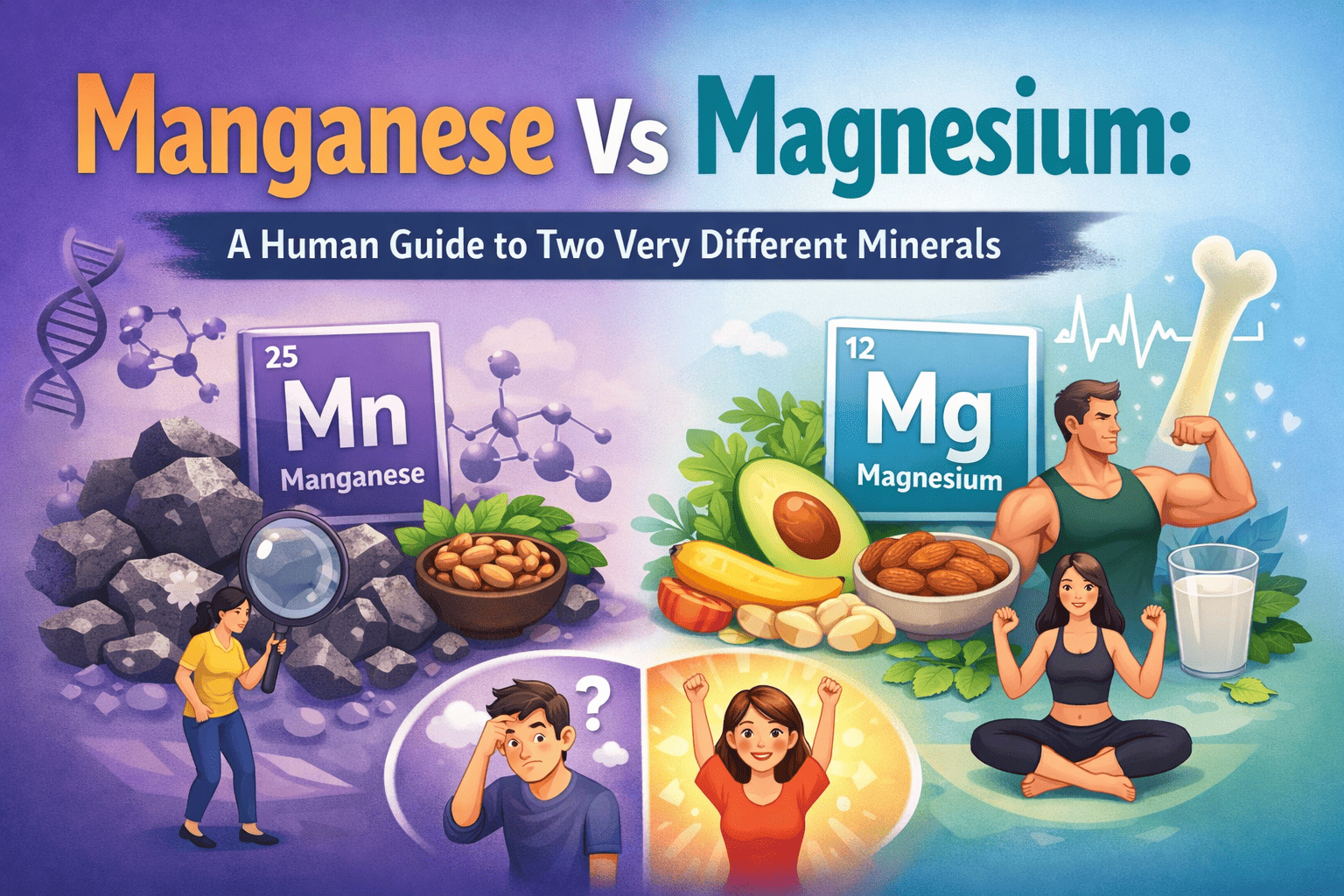
If you stepped into a chemistry class a couple of decades ago and heard someone say “Manganese vs Magnesium”, you might have scratched your head. Two names that sound almost like cousins, right? But dig a little deeper and you quickly find out they could not be more different.
In this long-form piece, we are going to explore Manganese and Magnesium from every angle imaginable, from the periodic table to your plate, from industrial furnaces to biochemical pathways, and even back to the way life itself manages energy and structure.
How They Are Related by Name But Not by Function
They are two different elements on the periodic table and each has its own personality, so to speak. They aren’t interchangeable in chemical reactions, biological roles, or everyday use.
Think of it like two workers in a factory: one is brilliant at tiny precision tasks, and the other is the muscle that keeps big machines running. Both are essential, but their jobs are not the same.
From a Chemistry Standpoint: Elemental Identity
Here’s a quick snapshot of how they differ at this basic level:
- Atomic Symbol: Mn vs Mg
- Atomic Number: 25 vs 12
- Typical Roles: Transition vs alkaline earth metal
- Physical Traits: Dense & hard vs light & malleable
These differences may seem technical at first, but they echo all the way down into how life uses these elements.
How the Body Sees Them: Biological Roles
Now, let’s walk out of the laboratory and into the kitchen, because both manganese and magnesium are essential for living organisms, including us. But again, if we imagine the body as a city, magnesium is like the city’s power grid, while manganese is like a specialist technician who fine-tunes important pieces of machinery in that grid.
Magnesium: A Macro Mineral
Magnesium is heavy duty. Our bodies contain tens of grams of it, mostly in bones but also in muscles, nerves, and every cell that produces energy.
Because it is needed in large amounts, magnesium is categorized as a macromineral. Daily requirements are in the hundreds of milligrams for adults, far larger than for manganese.
Manganese: The Trace Mineral That Punches Above Its Weight
Manganese is required by the body only in tiny amounts. But it is always critical for the health and it keeps many of our organisms functioning smoothly. It helps activating vital enzymes, making antioxidant protection, helping with bone development and metabolism.
Daily Needs and Dietary Sources
While both are needed by our body, let’s see how we can ensure consuming them through diet.
Magnesium in Your Diet
Magnesium is available in plenitude in most of the daily foods such as dark leafy vegetables, seeds, nuts, whole grains, legumes and a few dairy and fishes.
Because the body uses magnesium so broadly, hundreds of milligrams per day, it’s common for people to fall short, especially if their diet is low in these nutrient-rich foods.
Manganese in Your Diet
You’ll find manganese in similar foods, nuts, whole grains, legumes, leafy greens, but also unique sources like tea and certain shellfish. Because the daily requirement is so low, it’s possible to meet it easily with a balanced diet.
The stark contrast is in how much of each mineral you need:
- Magnesium: Hundreds of milligrams per day
- Manganese: Only a few milligrams per day
So while they can share food sources, the amounts your body needs are vastly different. That’s another clue to their distinct roles in physiology.
Industrial and Practical Uses of Both
Let’s now see the uses of both of these minerals in industrial materials and in our practical life.
Manganese in Industry
Manganese is used in steel production as well as in the manufacturing of other metal alloys. Manganese is known to be the toughening element in all metal alloys. It is also employed in batteries, ceramics, pigment production, and fertilizer manufacturing.
Because it can exist in multiple oxidation states, different electrical conditions depending on its electrons, manganese plays a versatile role in chemical applications that matter in manufacturing and materials science.
Magnesium in Manufacturing
Magnesium also has wider industrial and practical uses. Its lightweight nature, about two-thirds the density of aluminum, makes it useful wherever strength needs to be paired with reduced weight, from aircraft parts to automotive engines.
It’s also used in fireworks and flares because of the brilliant white flame it produces when burned.
When Things Go Wrong: Deficiency and Toxicity
Both manganese and magnesium are essential, but the effects of deficiency or excess are different, again, because of how the body uses them.
Magnesium Deficiency
Because magnesium is needed in such large amounts for lots of processes, deficiency can show up in ways that feel obvious or subtle: fatigue, muscle cramps, irregular heart rhythms, even mood changes. Many people don’t get enough from diet alone, especially if they eat a lot of processed food that lacks nutrient density.
Manganese Deficiency
Manganese deficiency is much rarer because the body needs so little. But when it does happen, it can interfere with bone development, glucose metabolism, or enzyme systems. Because it’s involved in so many small biochemical tasks, even a small imbalance can ripple outward.
Toxicity
Getting too much of either mineral from food alone is unlikely. However:
- Excess magnesium from supplements or medications can cause digestive issues like diarrhea or nausea.
- Too much manganese, especially from environmental or occupational exposure can lead to neurological issues because it affects the brain’s motor systems.
Your body is not designed to handle either one in massive doses, so moderation (and nutrition from whole foods) is key.
Manganese Vs Magnesium in Everyday Health
Most days, you’ll encounter these minerals through food, supplements (if you take them), or even water and your body will silently manage their use at the cellular level.
What’s remarkable is how distinct their roles are:
- Magnesium is everywhere from energy production, muscles, nerves, to heart health
- Manganese is more focused on enzyme support, bone formation, and antioxidant defense
Summing It Up
You cannot do without either, but the consequences of scarcity of any of them show up in very different ways. Both have been pressed into service by the universe to do work that matters. And both, in their own way, have stories worth knowing.