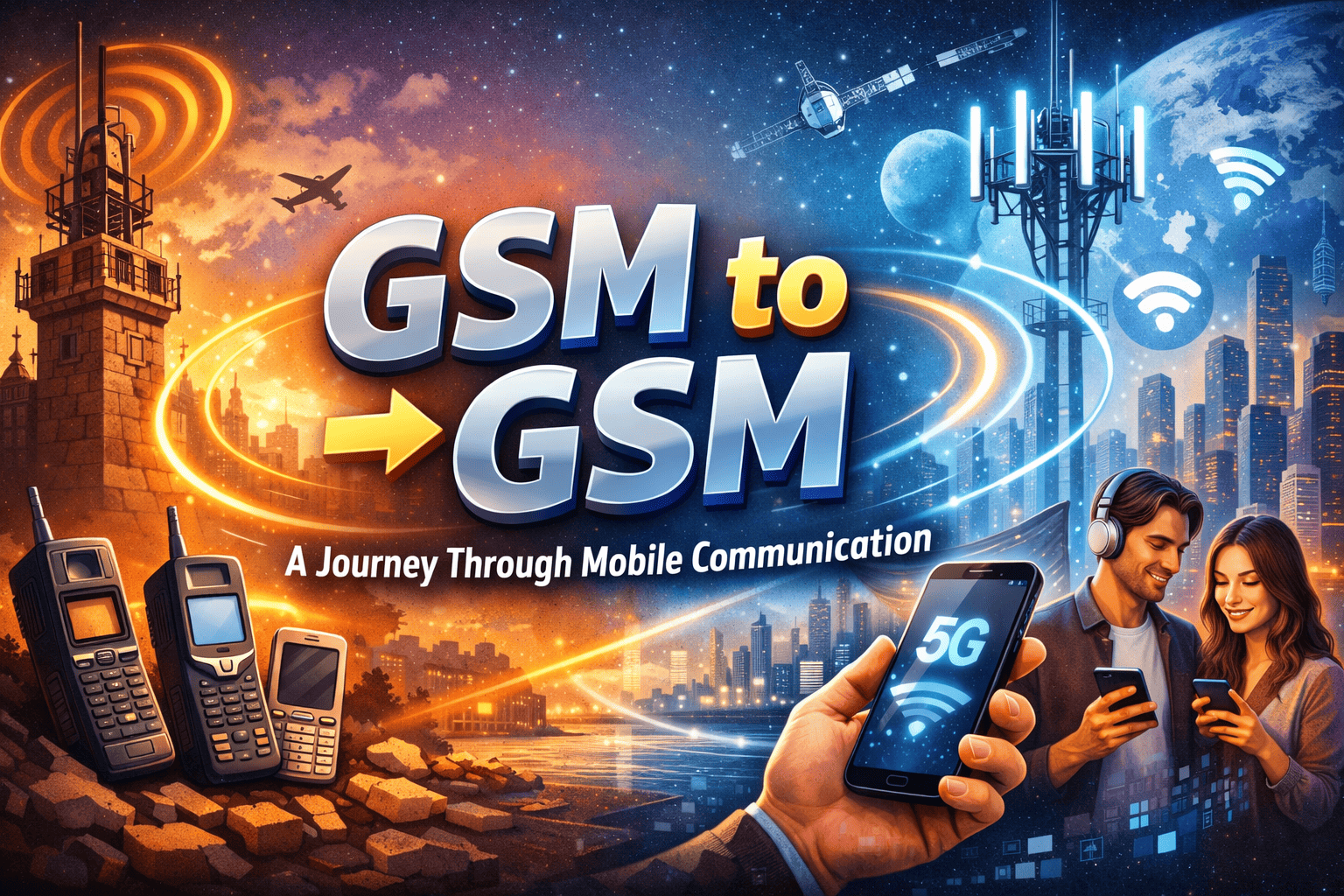
There was a time when talking on a mobile phone felt like holding a miracle in the palm of a hand. The voice was clear, the connection was new, and the idea of moving from place to place while staying “online” was almost science fiction. Central to that transformation was something called GSM, the Global System for Mobile Communications and moving a call or message “GSM to GSM” became, for many people, an everyday experience before they even understood what that really meant beneath the surface.
At its simplest, the phrase GSM to GSM describes communication that happens between two devices that are both attached to a Global System for Mobile Communications network. It means a message, a call, or a piece of data travelling from one GSM‑enabled device through the GSM infrastructure to another. But beneath that simple description lies decades of standards, hardware evolution, and engineering decisions that reflect how people and machines learned to speak to each other wirelessly across the globe.
To explain this in human terms requires stepping back and seeing how GSM was built, how it functions, why it became the dominant standard, and how the familiar act of moving from one network connection to another from GSM to GSM became seamless to millions of users worldwide.
The Origins of GSM: A Standard Born of Cooperation
When talk of mobile phone standards first started in Europe in the 1980s, there was nothing universal. Networks were fragmented, incompatible, and analog. Early mobile systems offered voice calling but suffered from low quality and limited capacity. It was the coming together of many national telecommunication bodies that led to the creation of a unified digital mobile standard. This standard, known later by its acronym GSM, stood for Global System for Mobile Communications, though its earliest roots were in a name that meant something slightly different, reflecting its origins among specialist mobile groups.
What made GSM significant was not just its ability to digitize voice. It was the introduction of a framework that allowed millions of people across nations to connect, share short messages, and later send data.
Each cell covered a geographic area, and these cells overlapped in a pattern that allowed a device to move physically from one area to another while preserving the quality of connection. This cellular architecture, familiar now because of its depiction in textbooks and online diagrams, formed the backbone on which the idea of GSM to GSM communication would be built.
How GSM Networks Are Structured
The first is the Mobile Station (MS), that is, the user’s handset equipped with a SIM card. The SIM (Subscriber Identity Module) holds the user’s identity and authentication information. It is the piece that allows a handset to register on the GSM network and be recognised regardless of the physical device.
Connected to this mobile station are the base stations that form the radio subsystem. These include the Base Transceiver System (BTS), which handles the radio communication with the handset, and the Base Station Controller (BSC), which manages resources and handovers between BTS units. Behind that lies the Mobile Switching Centre (MSC), along with databases such as the Home Location Register (HLR), which stores subscriber information, and the Visitor Location Register (VLR), which temporarily holds data while a user is roaming.
Each conversation, whether it’s text, voice, or data, travels from the MS through the BTS into the wider network, which may connect to other GSM networks or to public telephone networks. This is the technical backdrop for GSM to GSM communication: two devices, each connected to this wide, interconnected architecture, communicating through the infrastructure that supports it.
What Happens When Two GSM Devices Communicate
Imagine a call being made from one handset to another. Both devices have GSM radios and a connection to the network. The simple intuition is that the first phone calls the second, and that’s it. The reality, embedded in network engineering, is more complex.
When the first handset initiates a call, it sends a request to the nearest base station over a designated frequency. The GSM network uses a system of channels, both control and traffic channels, to manage these exchanges. Once the request is recognised, it is forwarded into the network’s switching system, which identifies where the second handset is located, checks permissions, allocates radio resources, and establishes the path for the communication to occur end-to-end. In this context, the communication, voice or otherwise, travels through the system from one GSM subscriber to another, hence GSM to GSM.
What the users experience is instantaneous: dial, ring, connect. But behind it, there are database lookups, resource negotiation, signal routing, and synchronization between network components. The intelligence of the network makes all these steps invisible to users, so that the act of moving from one point to another “just works.”
GSM and the SIM Card: A Human Touch to a Technical Standard
One of the innovations that helped make GSM widespread was the simple but powerful idea of the SIM card. Rather than tying a phone number and service to a specific physical device, the SIM card held the subscriber’s identity and credentials. This meant that a user could move physical devices but take their service and number with them. From a human perspective, this was transformative: swapping phones did not mean swapping identities.
That simple change also made the GSM network more flexible and adaptable. It made roaming the ability to use a device across different networks and countries possible in a practical sense. When two devices communicate GSM to GSM, the network does not need to know the physical attributes of the device as much as it needs to trust and recognise the subscriber. The SIM made that trust portable and practical.
Concluding Words on Security
When GSM networks were introduced, security became a practical concern, not just a theoretical one. Earlier mobile systems transmitted voice signals openly, making it easy for anyone with the right equipment to listen in. GSM changed that. Each subscriber received a unique identification, and every call and message was encrypted before it left the handset. The network used these identifiers and encryption keys to confirm that the person using the phone was legitimate and that the information stayed private.
However, the system was designed in the early 1990s. Back then, mobile phones handled only voice and simple text, and threats were limited. Modern hackers have techniques that the original GSM designers could not have anticipated. This we need to keep in mind.